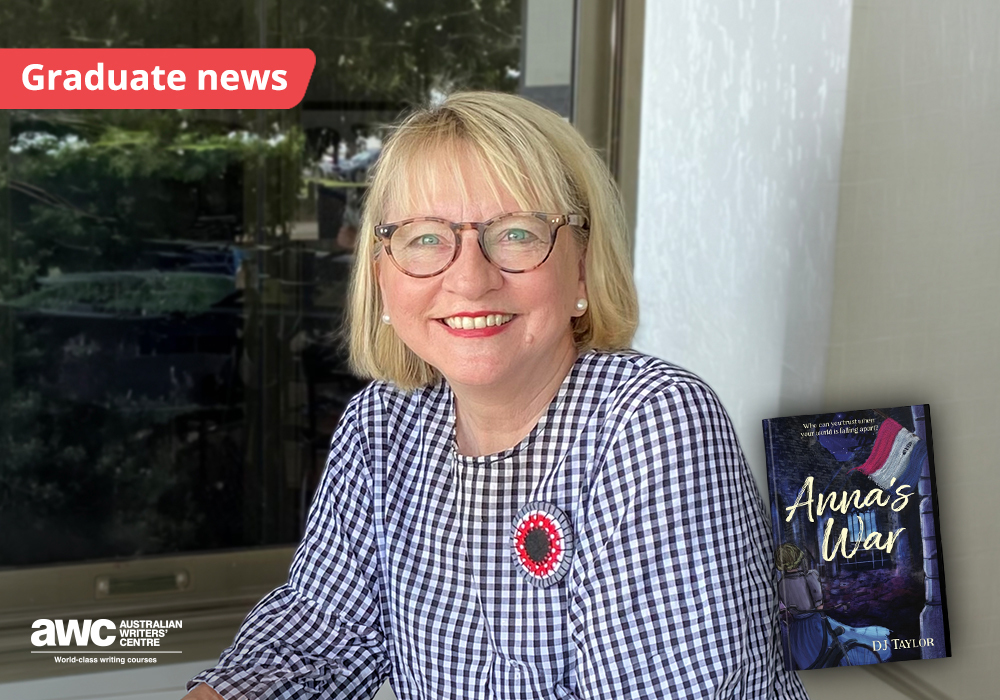
Di Taylor never set out to become a novelist. She simply wanted to find out whether she could write a book. The answer turned out to be Anna’s War (Riveted Press), a young adult historical novel published under her pen name, DJ Taylor – and her debut at the age of 71!
Before the book reached readers, an early draft was shortlisted, and placed third, in the young-adult section of a national writing competition. Behind that milestone were several courses at the Australian Writers’ Centre, among them Fiction Essentials: Dialogue, which Di credits with teaching her how to reveal a story through conversation rather than exposition. As she puts it, “never in my wildest dreams did I think I would be a published author.”
The spark for Anna’s War
Di lives in the small country town of Kilcoy, about 90 minutes north-west of Brisbane, but the roots of her novel reach back to wartime Holland. Anna’s War unfolds across the final 18 months of World War II in the southern Netherlands, and it grew from the memories of her Dutch-Australian parents-in-law, Catherina and Hendricus, who spent their childhood years living under German occupation.
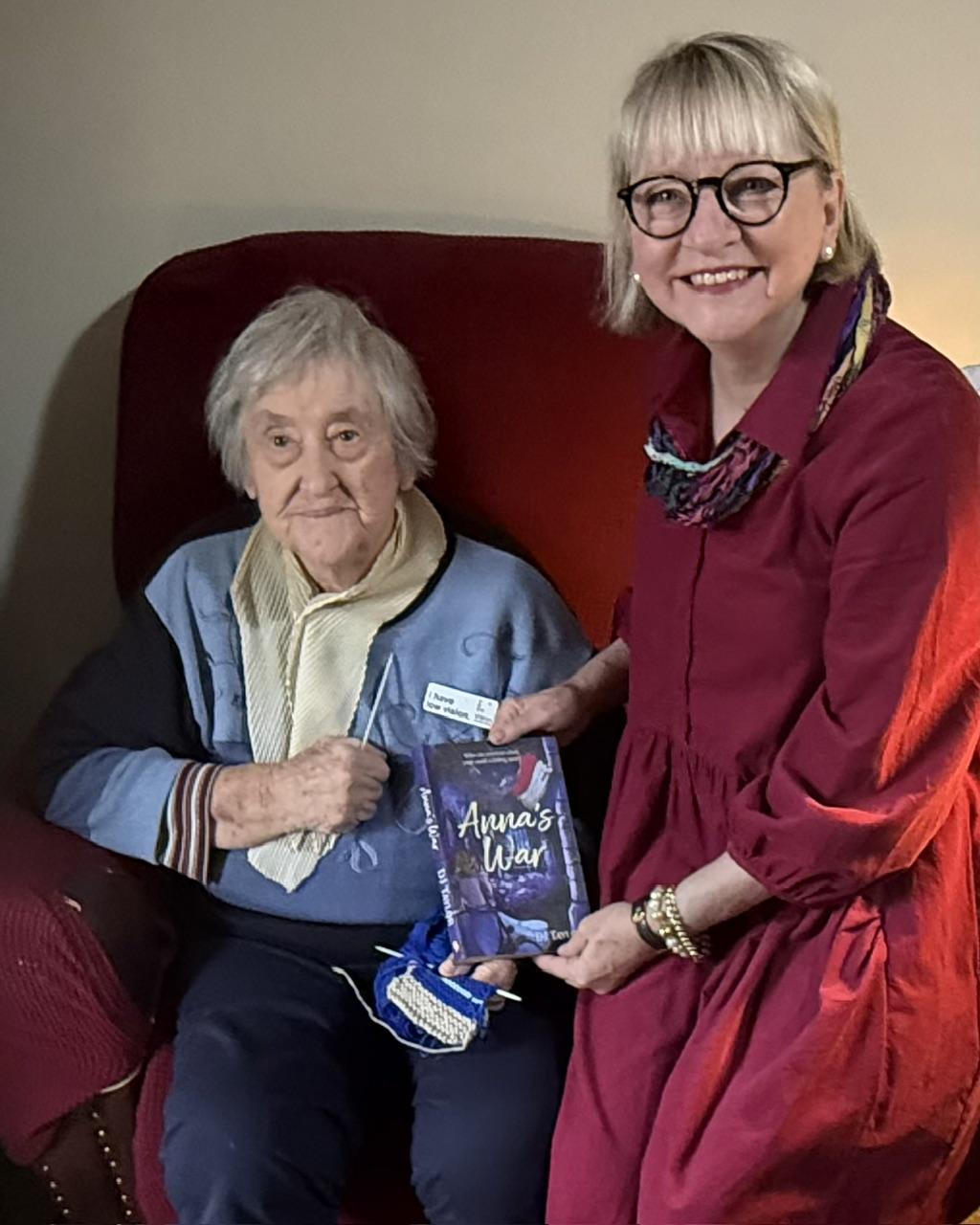
One comment from Catherina changed everything. “She told me how her father hid in a secret cellar under our house so he wouldn’t be arrested and taken to Germany,” Di recalls. “Each day she helped hide him. She was eleven years old at the time.”
That piece of history was little known to Di. Above the cellar where Catherina’s father sheltered, soldiers patrolled the streets, arresting able-bodied men and deporting them to work in German factories. As Di describes it, “More than 500,000 Dutch men were arrested and forced to work as slaves to keep Hitler’s war machine fully functioning. Forty-two thousand men did not return home.” That history sits at the core of the novel.
The result is fiction grounded in real experience. Fourteen-year-old Anna lives under constant threat: her father, a resistance fighter, hides in a secret cellar beneath the family home, and when Anna befriends a German translator working for the Nazis, she faces an impossible choice – can she trust him, or will he destroy her family? Drawing on the childhood experiences of three children who lived through the occupation, the book is, in Di’s words, “a story of courage, trust and survival in war.”
Di was determined to centre the people history tends to overlook. “I wanted to put the women and girls at the forefront of the story as they played a major role during the war in the Netherlands and they have largely been ignored or under-portrayed in history,” she says.
Writing without a map
For a self-described ‘pantser’, the way Anna’s War came together was a surprise. “I merely wanted to see if I could write a book as I enjoy writing,” Di says. She had never written fiction before, and when she tried to plot the story out, it wouldn’t cooperate. “I tried to plot it but I just couldn’t do it so I put Anna on a bike in the first sentence and off she went.”
What followed was a burst of daily writing. Di produced the 36,000-word first draft in seven weeks, writing a chapter a day. She flipped her day so writing came first, settling at her desk by 8am. “I wouldn’t leave my desk until the chapter was completed,” she says – give or take the odd cup of tea. “Each day I made writing my priority.”
Being a pantser suited her more than she expected. “The story had control of me rather than the other way around,” she says, and “The story had a life of its own.” As her confidence grew, so did her appetite for the work – she couldn’t wait to get back to her desk to find out what happened next.
She kept the whole thing to herself. Di didn’t tell anyone outside the family what she was working on – not out of secrecy, but because she had no idea whether she could write a book at all and didn’t want the pressure of people asking how it was going. As she later researched the war using old photos, diaries and newspapers, the manuscript grew from that first 36,000 words to a finished 62,000, with her parents-in-law guiding her on whether the scenarios she imagined could really have happened.
Learning the craft
Di came to fiction after a thirty-five-year career in the Queensland Public Service and, earlier still, a stint as a teacher-librarian – a role that had introduced her to countless picture books. Her first step into writing came from an unlikely place: a shop sign spotted while holidaying in Barcelona. “I spied a shop called ‘Have It Your Way’ and for some unknown reason I thought it would be a good title for a child’s picture book.” That idea sent her searching for a way to learn the craft, and she enrolled in the Australian Writers’ Centre’s Writing Picture Books course.
More courses followed as her ambitions grew. When she began Anna’s War, she leaned on Fiction Essentials: Dialogue, among other courses. “The course made it explicit how dialogue could be used in a variety of ways to not only develop characters but also advance the story,” she says. For a historical novelist, that lesson proved invaluable: “With historical fiction it’s easy to do an ‘info dump’ with all the historical research instead of the historical details being revealed through natural dialogue and action.” She kept returning to her course notes to stay on the right side of that line, and later built her publishing know-how through the centre’s Pitching and Publishing course.
Encouragement came from another corner of AWC too. “Whilst writing and redrafting Anna’s War I was, and still am, a keen listener to AWC’s podcast, So You Want To Be A Writer with Valerie Khoo. I also read many times the book, So You Want To Be A Writer by Allison Tait and Valerie Khoo. Both the book and the podcasts inspired me to keep going.”
The call that changed everything
When Di felt the manuscript was ready, she entered the first 5,000 words in the young adult section of a competition at an annual CYA conference. “To my utter surprise it was short-listed and then came third,” she says. She then refined the book further before submitting the opening 2,500 words for assessment by publishers at a subsequent conference. That is where Rowena Beresford, the publishing editor at Riveted Press, asked to see the full manuscript. Within three days, an email landed calling it a wonderful, wonderful story.
The contract offer arrived on a Saturday evening, and Di’s reaction was immediate. “I was stunned and immediately cried. I read the email several times to make sure I was taking it all in.” There was, however, one small complication. “I was doing ‘Dry July’ at the time and I got up and went to the kitchen and opened a bottle of red! I could not NOT celebrate!”
She is now at work on a sequel, prompted by readers wanting to know what happens to Anna and her friends after the war.
Di’s advice for anyone weighing up a writing course is characteristically direct. “Do it! If you are serious about your writing then you need to recognise the areas you need to know more about and there is sure to be a course for you. Yes, you can Google it but having a specialist course developed by experienced writers and publishers is the way to go. You will also meet fellow keen writers who can be a great support and your very own cheer squad.”
Follow DJ Taylor on Instagram, Facebook (Dianne Taylor) and at DJTaylorauthor.com.
Courses taken at AWC: