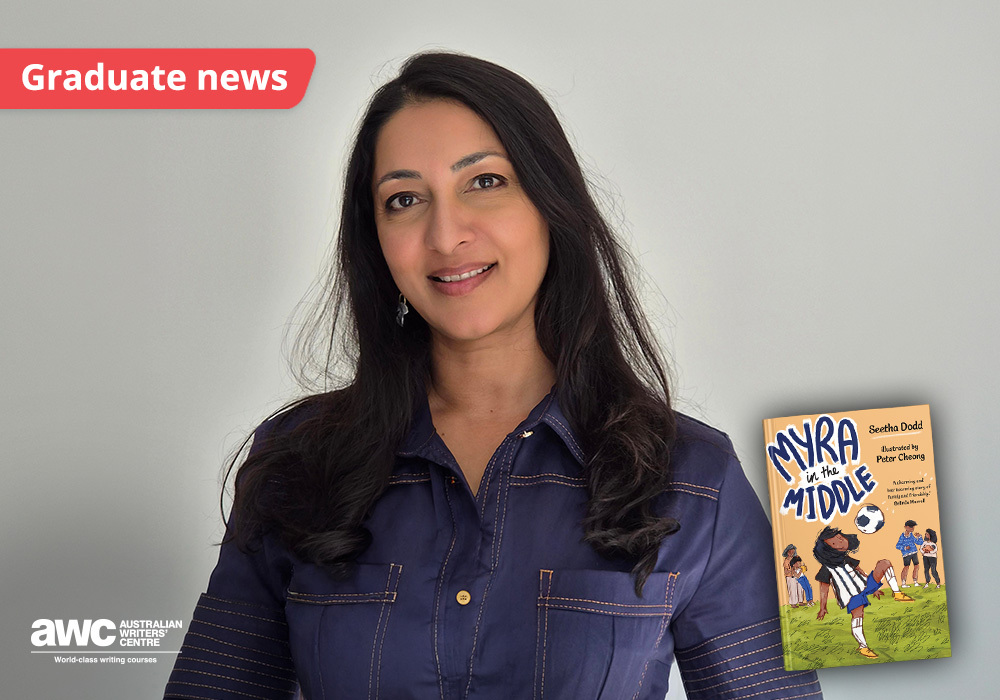
Northern Beaches author Seetha Dodd’s debut junior-fiction novel Myra in the Middle is on bookshop shelves now with UQP – a warm, funny story about a seven-year-old soccer enthusiast and Maths buff whose world tilts sideways when her baby brother arrives. Illustrated by Peter Cheong, the book is Seetha’s love letter to grandmothers, soccer, Indian culture and middle children everywhere. A string of Australian Writers’ Centre courses helped light the spark for her kidlit journey – with Writing Picture Books and Writing Chapter Books for 6-9 year olds among the most pivotal. She also has picture books on the way with Wild Dog Books and Larrikin House.
A creative outlet, finally
Seetha had to talk herself into taking the leap. “I was working full time, with three young kids, and wondering if I had the time or energy to commit to a course,” she says. “The self-paced option was perfect and gave me the reassurance that it was possible to fit this dream into my life.”
The catalyst was Furious Fiction, the Australian Writers’ Centre’s monthly flash fiction competition. Seetha was “lucky enough to be shortlisted” with her very first entry, and went on to enter the competition every single month – 42 entries in a row. “Writing 500 words to set prompts and a timeframe on a regular basis was a great way to practise, and to cultivate the discipline of getting the words down,” she says. “I recommend it to everyone.”
Even so, the course catalogue was intimidating at first. “Every time I picked one, my nerves got the better of me,” she says. Eventually she gave herself permission to go for it. “I only wish I had done it sooner!”
From freelance bylines to kidlit
The first Australian Writers’ Centre course Seetha took was Freelance Writing Stage 1 – and it opened doors quickly. “I loved how practical it was, and how it provided a clear path towards getting published in magazines and newspapers,” she says. “Using Valerie’s guidance and feedback through the course, I pitched to and was subsequently published in The Guardian, ABC Everyday, SBS Voices, SBS Food and Eureka Street. It was a huge thrill each time to see my name in the byline.”
A different kind of fire was lit when she signed up for Writing Picture Books. “I had also been eyeing the Writing Picture Books course for a while,” Seetha says. “When I finally signed up and started going through the modules, I realised a spark had been ignited and I knew I wanted to write for children. Doing that course (and attending my first kidlit festival) was a key instigator for my kidlit journey, and I am forever grateful to the AWC.”
From there, she added Writing Chapter Books for 6-9 year olds and a string of Fiction Essentials courses – Characters, Point of View and Dialogue – along with Your Author Website, Content Writing and Copywriting Essentials, building her toolkit one craft at a time. The feedback was a particular highlight. “I loved the feedback because it gave me an objective view of my writing – what worked well, and more importantly, how I could improve,” she says. The worksheets and reference guides became part of her ongoing practice too. “I had something to refer to after the course, which helped refresh my memory but also nudged me to put the learning into practice and just write!”
Inside Myra in the Middle
The seed for Myra in the Middle was a middle-child character grappling with her shifting place in the family. “I knew I wanted to write a story that had elements of my Indian culture, but the idea started out with a middle child struggling to come to terms with her new place in the family,” Seetha says. “As I thought more about Myra’s character and her journey, other themes appeared fairly organically – the story is also about self-advocacy, friendship, intergenerational bonds, soccer and mathematics! Myra’s voice was always clear in my head, and she was a wonderful companion in the process.”
As Seetha describes it, the book follows “a seven-year-old soccer enthusiast (and Maths buff) whose life is turned upside down when her baby brother arrives. Myra becomes a middle child, and everyone knows middle children always get forgotten! On top of that, Myra joins the school’s soccer team, only to be put in the midfield where nothing exciting ever happens.” With the help of her grandmother Muthashi, Myra learns to see her role as a connector – at home and on the pitch – and uses maths and logic to make sense of her changing world.
“This story is my love letter to grandmothers, soccer, Indian culture, and middle children,” Seetha says, “and is an exploration of family, culture and adapting to change.”
The path to UQP
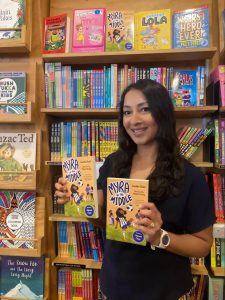 Seetha pitched her concept to Cathy Vallance from UQP at the KidLitVic conference. “Cathy liked the first chapters and requested to see more,” Seetha recalls. “I took a little time to polish the manuscript and after some initial feedback from Cathy and some reworking from me, the manuscript went to an acquisitions meeting. And it was a yes!”
The phone call confirming the deal brought a flood of feelings. “I felt many feelings – elation, gratitude, hope,” she says. “I’ve relived that moment many times in my head and I’m still pinching myself that I’ve been lucky enough to work with the team at UQP and with the incredible talent of Peter Cheong.”
The editing process was its own kind of pleasure. “I found the structural edit both challenging and rewarding – it was like a puzzle I had to solve,” Seetha says. “I am a plotter, so I mapped out the chapters, highlighted the bits that needed adjusting or moving, and worked out what I needed to add or remove to make the characters and the plot more consistent. After that came the line editing, which was the fun bit.”
Seeing her name in print was a full-circle moment. As a child in Malaysia, Seetha had a piece published in a local newspaper – but under a pseudonym, because she thought that was “a cool and mysterious thing to do.” “I never forgot that feeling of seeing my words in print,” she says. “Since then, I’ve been writing in various forms, but seeing my book on the shelves of bookshops and libraries, and in the hands of actual readers, is just incredible. And I make sure to use my name now. Names are very important, as Myra says.”
What’s next
There are more books on the way. “As well as junior fiction, I also love writing in rhyme,” Seetha says. She has a picture book coming with Wild Dog Books, and another with Larrikin House to follow.
Like many writers, Seetha fits her writing around a full-time job and the rhythm of family life. “I take a notebook and pen everywhere, and I am often scribbling away while my kids train or swim,” she says. Most of her writing happens at night, “when everyone in the house is asleep,” or in larger blocks on weekends.
Her advice for new writers
Asked what she’d say to anyone considering an Australian Writers’ Centre course, Seetha keeps it open. “Browse the huge list of courses and see what jumps out at you,” she says. “There is a suggested path for different genres, but you can also dip into short courses and see what sparks your creative flame.”
Follow Seetha on Instagram.
Courses taken at AWC: