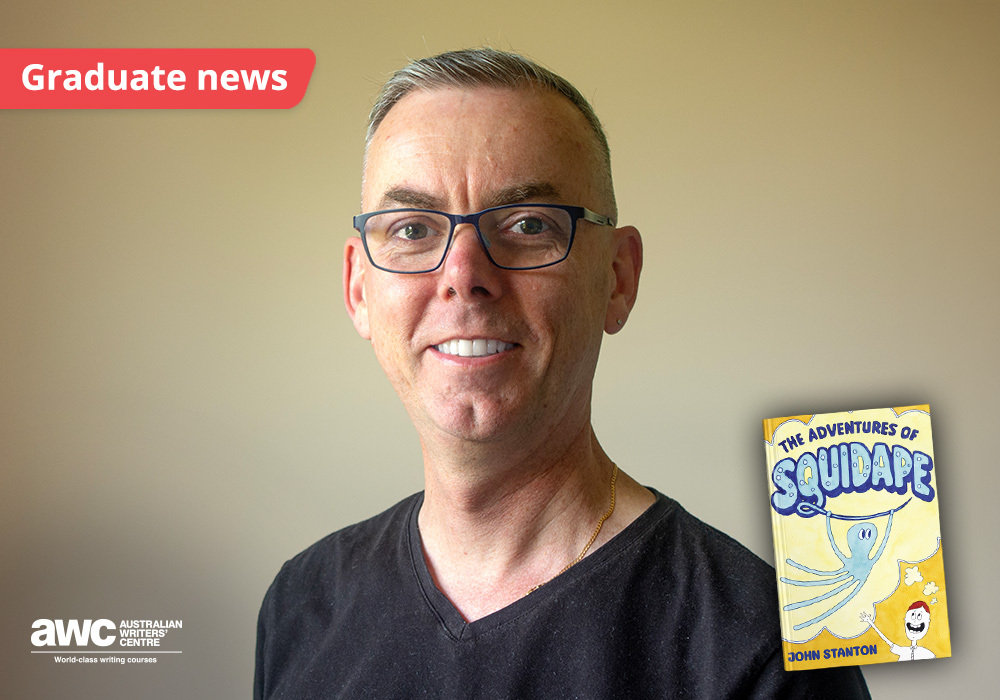
It started as a comic strip drawn on a scrap of paper at the kitchen table for two daughters who wanted bedtime stories. Two decades later, John Stanton’s middle-grade novel The Adventures of Squidape is being published by Riveted Press, with more than 20 of John’s own watercolour illustrations woven through the chapters – including the original Squidape comic strip that started it all. The teacher librarian from Walcha in northern NSW credits Australian Writers’ Centre’s Creative Writing Stage 1 course with helping him push through the editing wall that had stalled the manuscript for years.
“I’d been working on The Adventures of Squidape for a very long time – on and off for years,” John says. “I never thought of myself as ‘An Author’.”
A story that grew up alongside his daughters
John has worked in school libraries for more than 20 years and came to teaching later than most of his colleagues – “the wrong way around for most Teacher Librarians,” he laughs. Married, with two daughters, he and his family had not long moved from Sydney to a small country town when he discovered the Australian Writers’ Centre. By that point, the bones of The Adventures of Squidape had already been on the kitchen table for what felt like a lifetime.
“I drew a very short comic strip for my daughters, featuring a superhero called Squidape,” John recalls. “Our elder daughter also insisted on me making up a little story for her every single night. That was such an inspiring thing to do, but also quite a burden! I did feel as if my creative storytelling was stretched way beyond its limits! Many of those stories must have been completely boring, but nevertheless, traces of them found their way into the narrative that eventually became The Adventures of Squidape.”
As the story took shape, John painted watercolour illustrations to go with it – more than 20 in total, with at least one for each chapter of the book.
Getting unstuck
Despite years of work, John knew the manuscript needed outside eyes. “I felt stuck in my writing,” he says. “I had the bones of a story: some parts more complete than others. I kept working on it, over and over, until I’d looked at it so long that I barely recognised what needed changing to make it better.”
He went looking for help and found Australian Writers’ Centre’s Creative Writing Stage 1 course. “Of course, I did my homework to check that it wasn’t some dodgy tinpot setup, and once I was satisfied (which didn’t take long!), I booked.”
The weekly writing challenges turned out to be exactly what he needed. “The most useful part of the course were the weekly writing challenges,” John says. “They were definitely useful in sharpening my writing skills. There were specific challenges around dialogue, characters, or setting. There was feedback – from other participants as well as from the presenter. It was all really thought-provoking and challenging.”
More than that, the course pushed him to write outside the world of his own manuscript. “We were given prompts and parameters to write within, and that forced me to grapple with words instead of trying to drum up inspiration. One of the things about the course that I really appreciate is that it forced me to pay attention: to stop and really think about sounds, textures, light, and voices so that my descriptive passages and my dialogue conveyed the fullness of the setting or characters.”
He took everything he was learning straight back to the manuscript. “I was able to take what I was learning back to my story to make improvements based on what I learned. That was what I really wanted, but also it forced me to write characters or scenes in contexts I had never considered before.”
Inside The Adventures of Squidape
On the surface, The Adventures of Squidape is a crime story. Underneath, it’s the story of a boy who is, in John’s words, “a bit ‘stuck’”. Since the death of his mum, Roland Bickering-Jones has been struggling to make sense of things. His dad, Digby, runs an antiques shop – more of a junk shop, really – frequented by a crew of elderly customers known as The Collectors.
When Roland spirals into magical thinking, trying to rationalise his mother’s loss by imagining she is on a secret mission, one of those elderly friends suggests Digby take him to the seaside town of Yumpy for a holiday. But Yumpy is hiding a big secret: a suspicious antiques shop called The Itchy Fingers Emporium, run by people who seem suspiciously friendly.
“When Roland recognises an object he knows was stolen from one of his dad’s customers (‘The Collectors’), he soon discovers that paying attention can be a super power all of its own,” John explains. Squidape, the title character, is the superhero of an obscure comic-book series that Roland collects, and three of those comic strips appear in the novel itself.
The book is also peppered with Easter eggs – tiny tributes that John has hidden for his family.
“There are a LOT,” John says. “My original ‘audience’ (my family) can easily spot them, whereas all other readers will have no idea that they exist. They exist just for my family.”
From kitchen table to publishing deal
For most of those 20 years, John imagined nothing grander than printing and binding a couple of copies of The Adventures of Squidape for his daughters. After endless rounds of editing, putting it aside, ignoring it and editing some more, he finally let his wife and daughters read the manuscript. Then, taking an even bigger risk, he admitted to a friend that he’d written a book.
Around the same time, an opportunity surfaced. A publisher was looking for unpublished manuscripts in particular genres and age groups, and John’s book was a strong fit. The first hurdle was a fifteen-minute online pitch session based on a thousand-word extract and a story summary. He made it through. Next came a full manuscript submission and an hour-long online feedback session with the publisher. He made it through that too.
Then came the call. The publisher wanted The Adventures of Squidape – and they wanted his illustrations as well.
“Stunned, to be honest. Completely stunned,” John says. “It was hard to believe that it was real! I didn’t tell anyone outside the family until I knew it was certainly happening, because I didn’t know if the publisher would decide they didn’t want it after all. I am still nervous about sending my book out into the world. My hope is that it will be liked.”
Life now, and the leap into the world
Day to day, John is still juggling the very full life of a school teacher in a small country town.
For anyone wondering whether to take the leap into a writing course, John doesn’t mince his words.
“Quite simply, do it,” he says. “Anyone interested in improving their writing is going to need help at some point. Anyone who wants to start writing, and who feels intimidated or overwhelmed by it, will find the AWC courses an excellent way to get organised.”
Follow John on Instagram and on Facebook.
Course taken at AWC: